Yes,  ! I saw the report yesterday too and voted
  . Did you vote as well? The other person in the forum really hit the nail on the head. Excellent post from him.
2 Likes
I voted but I’m not sure that a direct mode is possible nor do I think it would solve the problem. I hate to be pessimistic but I think it has more to do with how much noise it generates because of how active it is when music is playing. What I heard from the Taiko Olympus suggests that the problem can only be solved by hardware that keeps Roon’s activity from generating noise that harms the music. That’s unfortunate because such a solution is prohibitively expensive for most folks.
1 Like
They are 
Your request for a true “Direct Mode” — bypassing RAAT and all processing layers for the most transparent, clock-accurate playback — has been noted and will be shared with our internal team for discussion.
Closed on Nov 13

In addition, we encourage you to post your suggestion in our Feature Suggestions section
1 Like
I agree. Roon will likely never be truly audiophile. Its strength is the rich, interconnected UI, but that very architecture makes it inherently not minimal for SQ. Even the best DACs, like Roon‑Certified dCS models, can’t fix that.
Roon would need two separate architectures , one for flexibility and one for pure SQ …which is extremely unlikely given their design and market priorities (broad user appeal, multi-room + metadata features, and ecosystem growth). HQPlayer, Squeeze and similar solutions have a much better chance of achieving that level of purist SQ.
1 Like
Hi Paul. I dont bother reading through the uodates Chaages any more , there seems no cirrelation between what they say and what I hear so I assume its the various other changes. I’ve also not seen Roon say “we’ve improved code to improve sound quality” probably because many systems don’t reveal changes in sound quality … even though thats probably occurred intentionally or consequently. I imagine when they do changes they listen to changes to make sure its not worse sound quality.
2 Likes
After a few days of testing (K30 G4, imho, ymmv) I have found that roon sq is improved by moving all storage from the K30 to my Synology. SSD’s are removed. This holds for streaming as well. The sound is now equivalent to Jplay which is all I need. I use hqplayer (bit perfect setting) embedded on the K30 so either roon or jplay can play to the player.
3 Likes
Interesting. I’ve also had the idea of adding another server to my K50 to relieve some of the load on the K50 server. Then I could use a Nucleus Titan, for example, or even a K41, in addition to the K50. Connect it via my Tempus switch and then listen. It’s all a bit redundant and probably pointless, but that was my thought. Maybe Roon would sound significantly better then. Has anyone else tried this?
Although, I don’t think that’s possible with my example. Then I’d have the K41 as the Roon Core or a Nucleus as the Core, then the K50 Server as the Core, and then the internal Roon Ready Player board. Hmmm, I don’t think that’ll work the way I thought it would. Never mind…
That was my reaction to what you posted, but I haven’t tried it either. I would just wait for Antipodes to reveal what they’ve got cooking with what’s next for software on Antipodes.
Thanks. The best SSD is no SSD, and not only for Roon. I’ve heard more users confirming that lately, not specifically with Antipodes servers. Looks like the day will come when we will hear our carefully stored music libraries just don’t sound as good as streaming. 
Now I’m wondering if removing an Antipodes-recommended Samsung PM893 used as storage would have a similar effect. The PM893 is supposed to be less noisy. From what I remember, you previously used a grey Samsung EVO as storage, and the two PM893 drives in the G4 upgrade were for the operating system.
Sorry—we’re drifting off topic again, just thinking out loud before getting back to the main subject.
Well, there’s been a lot of talk about it. I haven’t tried it myself yet. I just can’t imagine FLAC streaming sounding better than my WAV files.
And then there’s the fact that all the efforts Antipodes is making to improve Roon’s sound will most likely benefit all other server/player solutions as well. So in the end, I’ll probably end up back with Squeeze/Squeeze.
2 Likes
And so would I if I just played local files. Roon or to some extent Jplay is the gold standard for music discovery and curation. I was just so fed up with switching programs between discovery and playback. I am just now listening to the new Spock’s Beard which I have PGGB’d (16fs) and playing back roon to hqplayer (Bit Perfect) to my EX and totally engrossed. Prog On!
2 Likes
I’d prefer that we just share what we experience ourselves and not generalize on what others may or may not be experiencing. As I mentioned before, when my K30 first landed, files stored on the SSD sounded better than files stored on my NAS. Based on that experience, it sounds to me like you are providing bad advice in what I’ve quoted above.
Also I really don’t think Roon is the right application to use to assess this on Antipodes if that user is planning to also use Squeeze/Squeeze.
I was using an Innuos Zenith Mk3 before the K30. When using Squeeze, music stored locally on the SSD also sounded better than music from my NAS and it was not difficult to hear the difference.
As with everything in this hobby, the best advice is to suggest that everyone listen for themselves and decide based on what their own ears tell them.
2 Likes
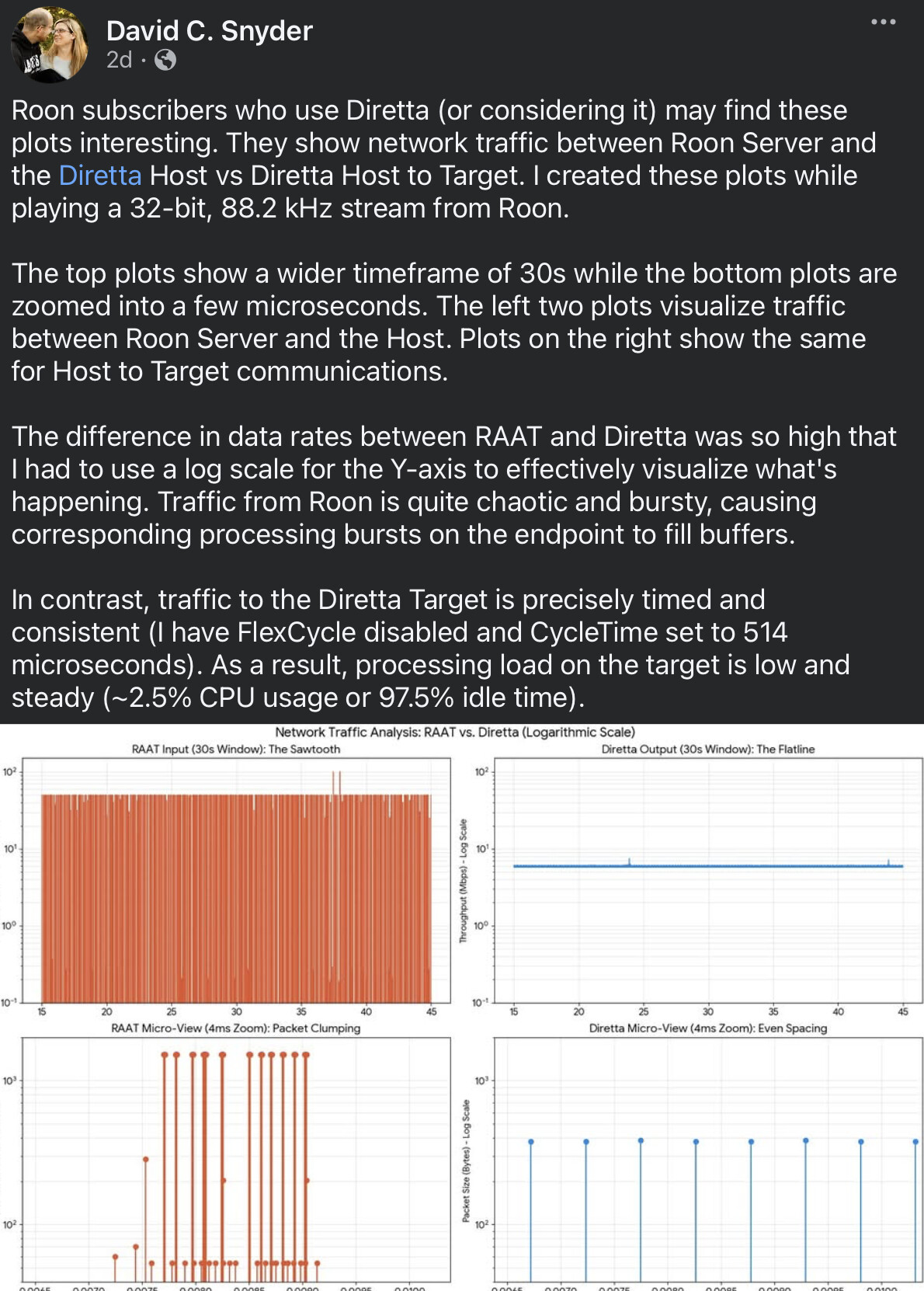
The following was posted to the Diretta Users group on Facebook. I cannot attest to the accuracy of his data, but I thought the charts were fascinating nonetheless. I think he nails with this quote: “Traffic from Roon is quite chaotic and bursty, causing corresponding processing bursts on the endpoint to fill buffers.” I don’t recall exactly what Emile from Taiko has said but I believe it’s the bursty behavior that he’s sought to make networking less-bursty as doing so would reduce noise. Fascinating stuff.
3 Likes
I was replying to @Progisus who removed his SSD — the thread layout makes that clear.
Didn’t mean to consume extra thread-space with off-topic reflections, so no need to reinterpret my comment for others. It wasn’t aimed at your setup at all.
Yeah perfectly clear that you were advancing a suggestion that only applied to one person’s situation. Not sure how I missed it.
That’s a nice coincidence. I actually had email contact with Mark earlier this week regarding the possibility of implementing Diretta support on Antipodes devices. My suggestion was that the server could act as the Diretta host while the player could function as the Diretta target.
A major advantage of this approach is that CamillaDSP can be used in combination with Diretta, which opens up some really interesting possibilities. For what it’s worth, I’ve personally had excellent results using Gentooplayer in addition with Diretta. I found GP on it self sounded very spacious and clean, while the Diretta protocol added naturalness and soul.
From what I understood, the team is currently busy with other projects, so Diretta may not be on the roadmap in the short term. Still, I’m curious where the balance lies: if there is strong community interest, could this influence future development?
In my view, Diretta support has a lot of potential, and it would be great to see it considered down the line. It would be very handy to be able to use DSP on SOURCE level for slight corrections…
1 Like
The only complaint I have about this server doesn’t relate to the server itself, I believe, but rather the app, Jplay. I find that while multitasking on my iPad it will stop playing in the middle of a song. In other words, it appears that lately I must have the app open and cannot multitask on my iPad while music is playing. It has not been a top priority for me so I have not reached out to the company for a fix unless somebody reading this post happens to know the remedy…
When switching from Jplay on my iPad, I do not close it down but leave it running in the background. It does not send the full playlist all at once sometimes.
1 Like