Another, and for me final, test confirms that the control source significantly impacts sound quality. I ultimately conducted the final listening tests using only Squeeze/Squeeze. I even borrowed my wife’s Samsung Galaxy smartphone and Samsung Galaxy tablet (the very latest models) for comparison. The Samsung devices sounded exactly the same as my Google Pixel devices. Regardless of whether it was a Pixel or a Samsung, Squeeze/Squeeze sounded more cohesive and balanced when controlled via the smartphone. Conversely, regardless of whether it was a Pixel or a Samsung, Squeeze/Squeeze sounded more open, refined, with a wider soundstage, clearer, and less harsh when controlled by the tablet. I can consistently reproduce this result. In fact, I find the sound significantly better when controlled by the Samsung Galaxy tablet than when controlled by my Pixel tablet.
Thank you very much 
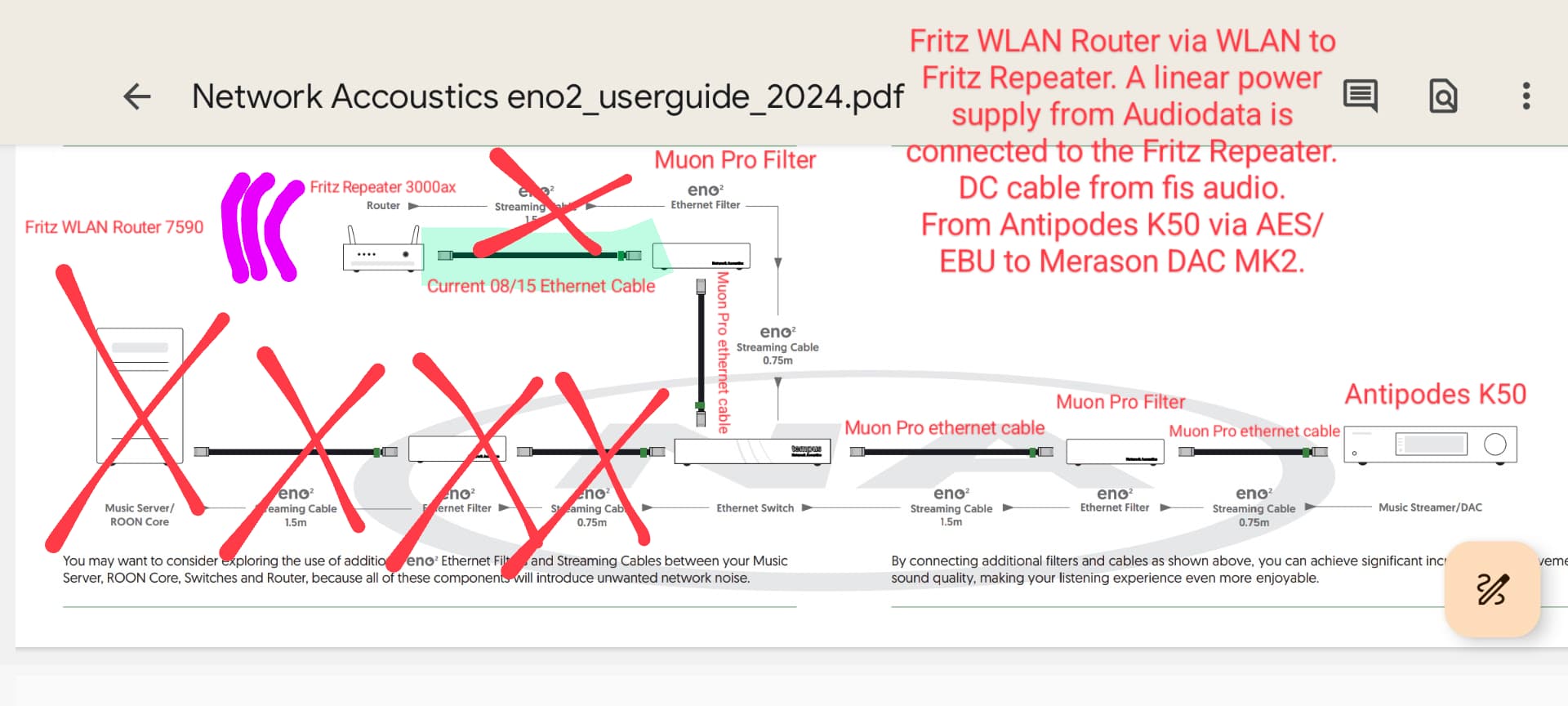
My lack of familiarity with the Fritz products has made deciphering your setup difficult, though the illustration helps.
Your use of a repeater is a key difference between your network and mine. I wonder if your different devices vary the load placed on this.
Of course you will have another “actor” on the network and that can change something…
I’m now testing without the repeater. I’m bypassing that network bridge. I’ve connected a long Ethernet cable directly to my Fritz!Box. From there, it goes to the first passive NA filter, the Muon Pro. So the path is the same as in my diagram. And I certainly agree and understand that multiple devices on a network can lead to more noise, but in my case, it’s minimal. And the sound differences are enormous depending on the device (tablet, smartphone, Windows laptop). Furthermore, I switch each device to airplane mode afterward, and there’s virtually no change, or only a marginal one.
Hi Christian,
I understand your observations and I appreciate your thorough testing. It seems that every wireless device gives a different sound when controlling the K50. Let’s assume this is probably because WiFi, EM fields, or power circuitry in each device subtly affects the environment, I mean not the audio data itself. (Btw. how far is the controller device from the K50, in case?)
I think the most definitive way to test this is to connect each device over Ethernet (with a USB‑C to Ethernet adapter and a few meters of ethernet cable) and disable WiFi entirely. If the sound differences disappear, we know the wireless path through Fritz!Box Wi-Fi router was the culprit. Note that some (wifi)-routers may still prioritize traffic differently depending on the device type or polling patterns, though this effect is usually tiny.
PS: Even if you put your device in airplane mode and connect it directly to your K50 via Ethernet, the Fritz!Box is still handling all the Wi‑Fi traffic in your home. Using a dedicated audio access point (and optimal settings for low noise) connected to your Tempus means that only your control devices are talking to the streamer, keeping them separate from everything else. This is a really clean way to test if the Fritz!Box Wi‑Fi setup is causing the differences you’re hearing.
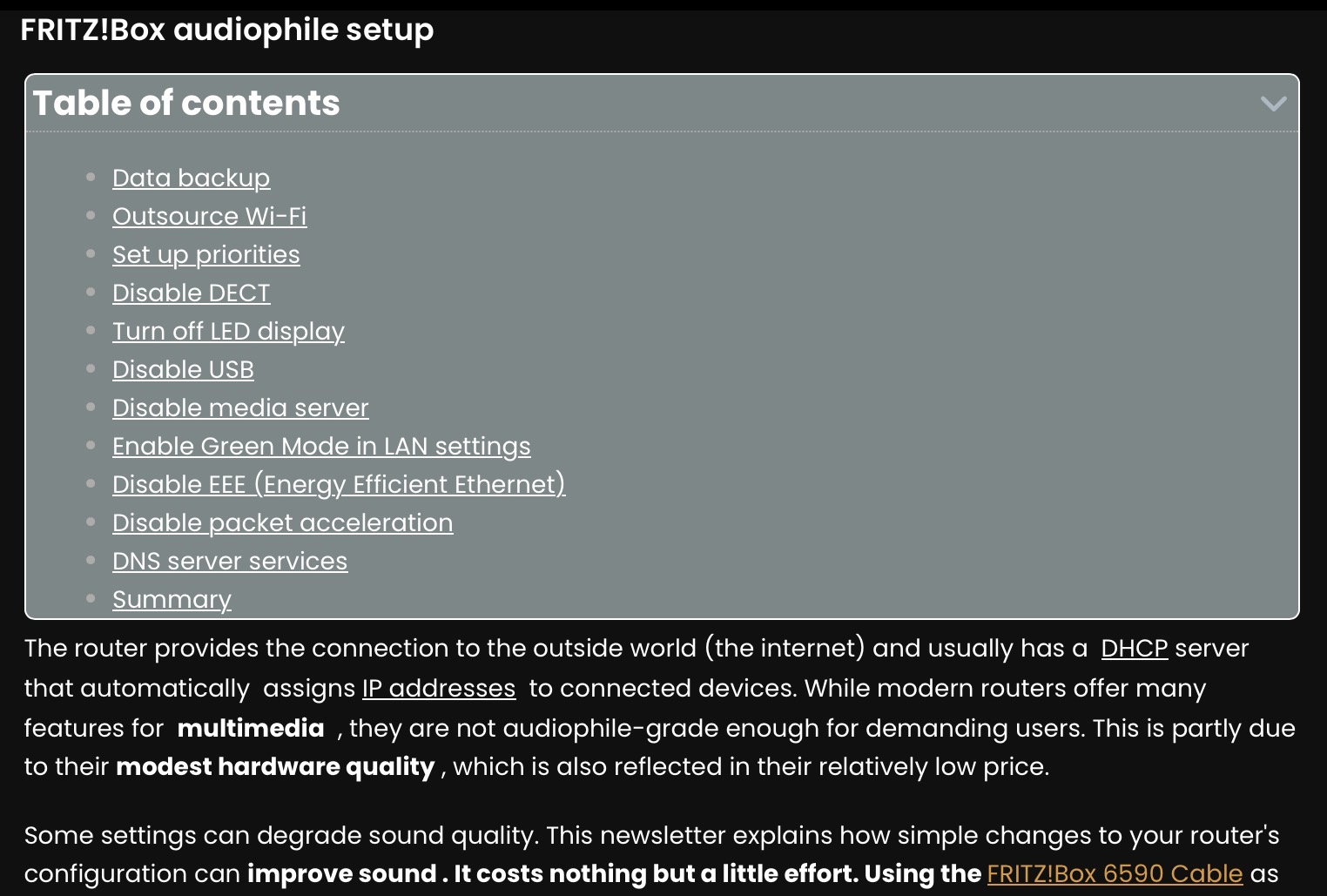
PPS: Just in case the Fritz!Box is playing a role, there are some proven tweaks you can make to lower noise and minimize any impact. It won’t hurt to apply them, even if they don’t end up being the main cause… FRITZ!Box audiophiles Setup – Grigg Audio Solutions
Hi PaulW, I’ve finished the tests for now. I want to make it clear that I don’t mean to alarm anyone, I just wanted to share this. I’ve been battling network noise for a long time, and I immediately hear a difference when something isn’t right or has changed. So, with a direct connection to the Wi-Fi router (i.e., without a repeater or Wi-Fi bridge), and with the NA network cleanup still in series, I can again detect a clear difference in sound. Various smartphones, tablets, and laptops all sound different when controlled via Wi-Fi. It’s always Squeeze/Squeeze. I’m always playing my WAV files from the internal SSD (K50). The sound of the music either becomes more spacious and wider, or it becomes more closed, narrower, and therefore more present. When controlled with the Samsung tablet, the music sounds a bit brighter and remains more closed in its musical presentation. The distance between the tablet and the K50 is 4 meters. But I always diligently switch to airplane mode. Whether airplane mode is on or off, the difference in sound is very marginal. The difference in sound remains marginal even when all devices are active on the Wi-Fi network, i.e., not in airplane mode. So I can confirm that the sound differences remain the same regardless of whether a direct connection to the router or my Wi-Fi bridge is active. The sound becomes interesting again when my Wi-Fi bridge with the 7m ViaBlue cable and the NA Origin power supply is reconnected. Immediately, the music becomes more harmonious and open, and the sibilance almost completely disappears – it doesn’t sound digital at all. However, the differences depending on which device is in control still persist.
I appreciate how carefully you’ve been listening and documenting differences and that’s extremely valuable. The only thing that hasn’t been tested yet is the one variable that could settle this once and for all: removing the Wi-Fi layer from the control path.
Not by switching devices or airplane mode, but by changing how the device communicates.
I honestly think you’re close. With just one or two more controlled tests, you could either prove your hypothesis or rule out wireless as the cause and both outcomes are progress. 