In any case, it will make a big difference. The Tempus will remove a lot of noise for you, too. Just try it and listen. And if you don’t like it, send it back.
2 Likes
Oh, it’s very important to mention, or I particularly noticed, that the Tempus sounds very natural, or at least tries to maintain it. Many switches impose a significant sound stamp. I didn’t notice that with the Tempus. It simply and neutrally reduces noise, and that’s very important to me, since I don’t want to change my sound signature.
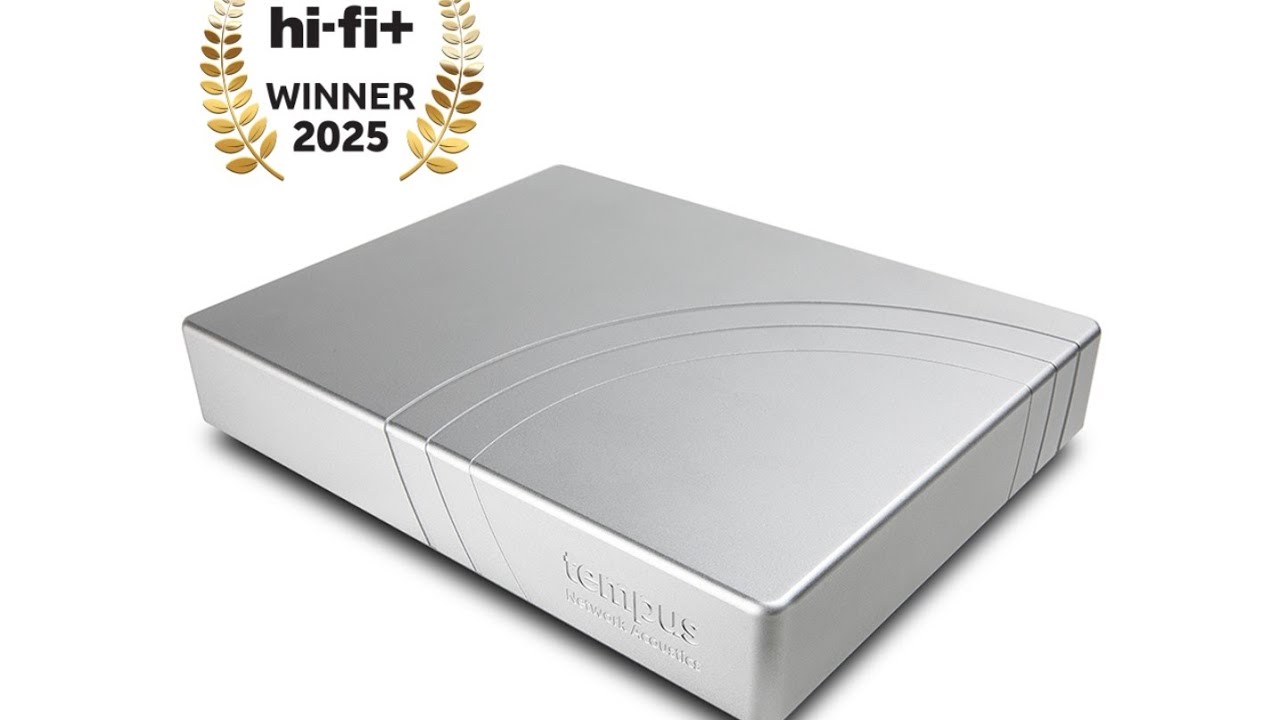
A recent positive review that may be useful, the power supply seems to be very beneficial.
1 Like
Tempus or Muon Pro filter, if only listening to music from built-in SSD, which one would you buy?
Thanks for sharing your experience with the Tempus! To compare apples to apples, it might be helpful to also mention which power supply you’re using and whether you’re using any Network Acoustics cables, since those can influence the switch’s performance.
It was apples to apples as the EtherRegen with Farad Super3 came out and tempus with its own Mk2 supply went in.
The cables all remained the same with the DC cables being only the exception. Exiting the Super 3 was an Audio Sensibility Signature Silver cable while the tempus comes with its own DC cable.
The EtherRegen initially had the deck stacked in its favor initially. Following the Audio Sensibility cable and feeding the ER was a QSA Lanedri DC cable extension This was a special edition cable that sold for $1000 when introduced. It extends any DC cable featuring a 2.5mm barrel connector. I am not sure I have heard another cable that offers more of an improvement than this. I wanted to hear the stock tempus before tossing this in so when I first reported on the tempus clobbering the ER with Farad, the DC extension was sitting off to the side. I did finally toss it in last night. The improvements were significant. Tough throw out numbers but the magnitude of improvement might have been 30% of the improvements I heard from swapping in the tempus as it simply dialed up all the gains the tempus brought.
Two other QSA Lanedri cables were recent additions and brought over from the ER: the Discovery Veridion ethernet cable made the connection between switch and Antipodes and a Discovery Veridion power cord powered then switch. These are $250 cables that outperform cables costing a lot more. I highly recommend auditioning these before the price goes up.
Lastly, the fiber that fed my ER is now feeding the tempus. I have some more Discovery Veridion on order and will compare that to the fiber when it arrives. I’m guessing fiber’s days are numbered.
This is excellent advice. What’s interesting is that Rob from NA had this to say: “To date we have not had a tempus returned”.
2 Likes
Both! A very good switch will, of course, remove most noise.
I hear improvements regardless of genre. Last night though I finally played some orchestral music. Noise stripped away by the switch has allowed much more low level detail to emerge. I had never before been transported to the venue so convincingly. It actually leaves me more impressed to hear what my Antipodes server can do when it has less network noise incoming.

2 Likes
Thanks for your detailed write-up! Based on your 30% improvement claim with the QSA Lanedri DC Extension on top of the stock Tempus DC cable, ER + Farad Super3 could roughly be seen as 50–70% of the Tempus + Mk2 PSU gain, just based on perception — that’s my estimate. Give or take a percentage point, very impressive.
Replacing the fiber feed with the QSA Lanedri Discovery Veridion Cat6 Ethernet cable* is likely to add another ~15%.
Of course, both systems were already lifted significantly by the PSU fed with the Discovery Veridion AC power cord and the final Ethernet connection to the Antipodes via Discovery Veridion Ethernet.
*The longer the Discovery Veridion Ethernet cables, the greater the impact on performance
The QSA extension cable scaled much further with the Tempus than with the ER. The higher noise floor of the ER kept the extension cable from showing off how much it could reveal.
I expect it to be a bigger deal than that based on hearing what their Gamma Infinity Ethernet cable did in my system. I’m thinking it should be at least as significant as the QSA-treated DC extension cable. I should point out that I just sold my Shunyata Sigma Ethernet cable. That was a $2000 cable and yet I preferred the $250 Discovery Veridion. So I will essentially be replacing fiber with a cable that is, at worst, the equal of a Sigma. But it is likely to be much better because I will be placing at four of them in series. See this post for an explanation (though maybe you’ve already see this).
[My fiber span is 8m so I need four 2m cables to cover the same distance.]
No, I hadn’t seen that—very interesting. Also surprising that they’ve only recently started looking at network improvements, so probably more to come.
By the way, you didn’t mention clocking for the ER in your apples-to-apples comparison. Did you end up moving away from the Mutec Ref 10? I thought that was still part of your setup?
So where does the switch go?
I have broadband fibre> broadband box> ethernet cable > Netgear modem/router >ethernet cable > Oladra
Does the switch go between the NBN box and then one output to the Netgear and one separately to the Oladra?
Or does it go right before the Oladra?
Good memory. Yes I had REF10 SE120 but I sold it a few moths ago to fund the purchase of a T+A DAC200. That DAC replaced a Gustard x26pro,’which benefited from the clock a bit more than the ER did. Before I boxed up the clock, I did spend time with it just providing a reference to the ER. It helped but the improvement didn’t justify keeping dollars tied up in it.
My favorite upgrades are the ones I can do at “revenue neutral”. That’s where the proceeds from what I sell at least cover what I am buying, thus no dollars out of pocket to get a nice bump in sound quality. Selling the clock plus the power cord I was using with it pretty much exactly covered the cost of the used DAC200. I actually came out ahead on that one after selling one of my two clock cables. The DAC200 brought a huge upgrade so it was wonderful that I got it with no additional outlay of money.
I’ve not had any outlay of cash either with the QSA Discovery Veridion cables as the selling the cables that they replaced pretty much paid for them.
The tempus required an outlay of cash but it’s been worth every dollar. The ER plus Farad was relocated to my AV system where it has improved both audio and video.
1 Like
Great to hear about your exciting journey with the Tempus! What power cord are you using for it? And you might also try isolation of the Tempus and power supply to get even more out of it.
And how did he connect it? 
Something like this, I think:
ISP/Router → Fiber (QSA Veridion Ethernet later) → Tempus → (QSA Veridion Ethernet ) → Antipodes
                       Tempus
                            ↑
                    Tempus Mk2 PSU
                            ↑
  Stock Tempus DC Cable  (+ QSA Lanedri DC Extension added later)
                            ↑
      QSA Veridion Power Cord  (mains → Tempus PSU)
1 Like
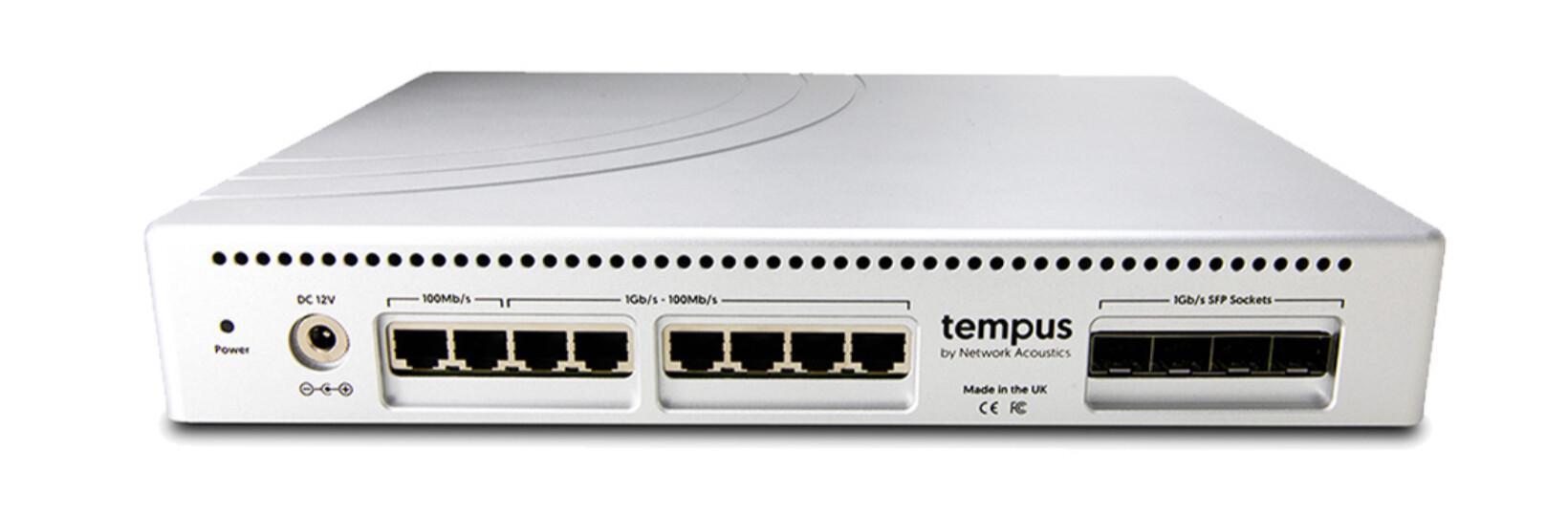
Presume he used the 1GB connectors rather than 100MB?
Right now I’m powering it with a QSA Lanedri Discovery Veridion. The main chassis is sitting on Stillpoints Ultra SS. Due to shelving constraints, I have the power supply resting on top of the main chassis. I have these MoFi feet incoming as I just spotted them for sale. Not sure how good they are but since HRS was involved I’m guessing these will have a positive benefit. I will place these between the power supply and main chassis.
Absolutely 1 GB. I’m so thrilled to finally not be restrained by that when copying large files across.
Almost. Presently:
ISP/Fiber ONT→ Unifi router → long run of generic CAT5e in the wall → wall jack in listening room → generic CAT6 → Sonore opticalModule → 8m fiber → tempus → QSA Veridion Ethernet → Antipodes
The Unifi router is being powered by an iFi iPower Elite. Power cord is QSA Veridion and a QSA DC Extension cable is used between the Elite’s captive DC cable and Unifi router.
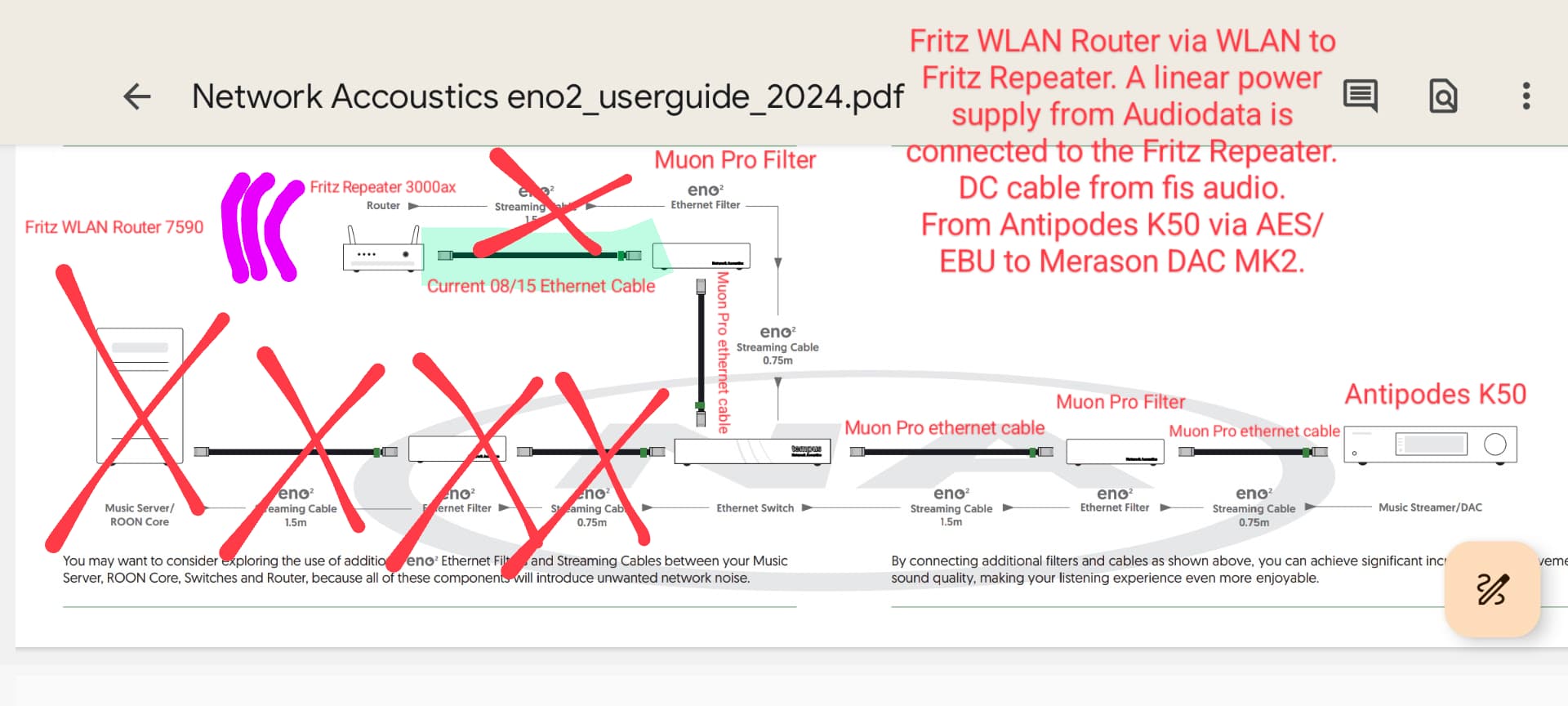
The switch is usually placed in front of the server/streamer. In my case and yours, that means in front of the K50, or like you, Oladra. But you can try a lot of things. There are so many opinions and ideas on this, you will always have to try things out. Always! For example, I haven’t installed any fiber optics. I’ve attached a screenshot of how I’ve done it so far. Well, I can’t say whether it’s right or not so good. I’ve spoken a lot with Rob from Network Acoustics. I’ve listened to him a lot. It sounds good to me. But I can’t say how much noise is still leaking through my K50 (even with all the Network Acoustics equipment installed). Network Acoustics, for example, doesn’t have any fiber optic kits in their shop. But that doesn’t necessarily mean that the installation or mixing with fiber optics is wrong. Ask Rob yourself; he always answers. There are a few updates to my screenshot. The standard Ethernet cable from the repeater to the switch has been replaced with a ViaBlue™ EP7 Silver RJ45 CAT6A network cable (length: 7.5 meters). The Audiodata power supply for the repeater has been replaced with an Origin power supply from Network Acoustics. And yet, I have to say that when I close the Squeeze web interface after selecting music, I can clearly hear the music becoming even quieter. It feels a bit quieter.
3 Likes
Hay:
I did it the other way around. I started with a Muon Pro System. It was a huge step up from hard drive recording. I’m wondering if it’s worth the extra money for what I’m going to get with the Tempus. I think if you start with the Tempus, you’ll end up buying the Muon Pro System.
1 Like