I am certainly starting to feel as if I’m being pulled in that direction.
1 Like
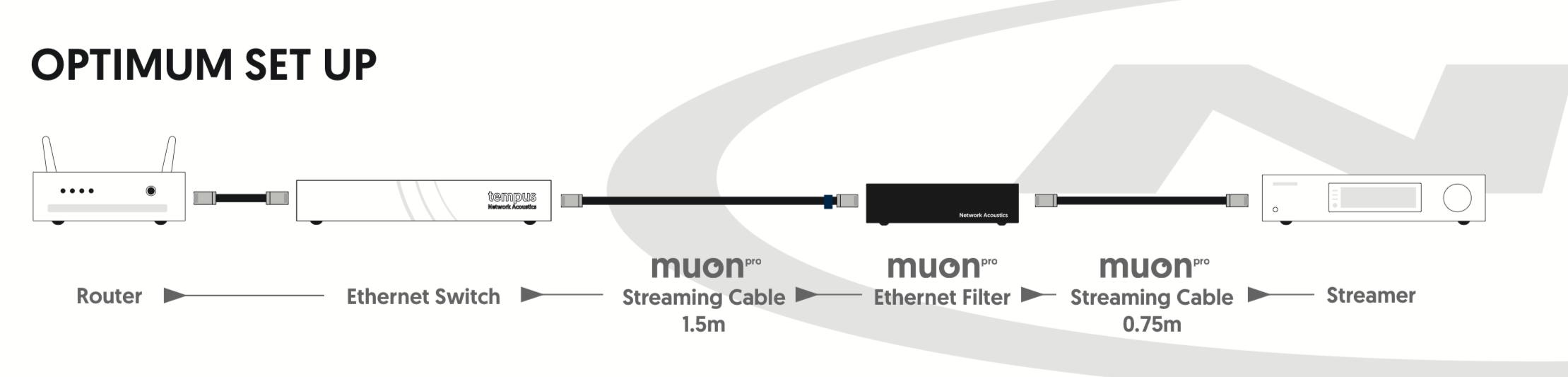
Thanks for bringing attention to the illustrations in the user guides for their filters. First time I saw them recommend a filter both before and after the switch. You don’t mess around as it appears you have the muon pro both before and after. I think I will eventually aim for the “optimum” configuration show in the muon pro user guide (below). I wonder though if an eon2 after the switch might be good enough. I will check with Rob at some point.
1 Like
Ya that’s also the way I went. Starting with a Muon Pro, then getting a Tempus. This felt like heaven. Also an ENO2 is providing great value.
1 Like
That’s what happened to me, and after being similarly surprised and impressed by the Tempus, after using SOtM, Melco and EtherREGEN switches, I tried the Muon Pro System after the Tempus. I was very surprised that the sound improved further.
What is very impressive about Network Acoustics, is that when you add something more, it seems to have just a positive impact, at least so far, cleaning up the sound but keeping all else in balance.
This discussion is inspiring me to consider whether adding more more Muon Pro filters earlier in the chain will also be positive.
It has been said many times, but in addition to their great products, Network Acoustics are an absolute pleasure to talk with, and are very accessible, and just give great support…rather like some NZ companies…
2 Likes
I had previously tested the Eno2 (installed before the Tempus). I had already owned a Muon Pro streaming system (installed after the Tempus). So I tested the effect with a filter in front of the Tempus. I didn’t like the sound of the Eno2. The sound was too pale. I felt the timbres were missing. The sound impression with the Eno2 was spacious and tidy, but I wasn’t satisfied. I then returned the Eno2 and got the Muon Pro. I liked the sound better. The timbres on the Muon Pro were better. The music had more drive. So in my system…
3 Likes
What did the Viablue cable soundwise?
NA Origin PSU – Something New?
Network Acoustics’ Origin PSU is marketed for “digital devices.” Originally conceived by NA to tackle noise from routers, the recent Origin Streaming Power Supply builds on their earlier Tempus PSU. Like the Tempus it’s hybrid, but now with a metal case instead of plastic and a much broader scope ; supporting switches, streamers, DACs, and optical converters.
Curious to see how Origin + Tempus performs and whether the benefits observed with routers fully carry over to switches.
So you can’t go wrong with this cable. The price/performance ratio is great. Much better than my previously run-of-the-mill Ethernet cable. Improved tonal quality, noticeably more open sound. Cleaner and deeper bass. Not too bright, too soft, or too dark. Takes some time to break in. This 7.5 m cable with the ViaBlue was immediately noticeable. The 7.5 m cable cost around €350. I was also considering using the Cardas in this case, which would have been around €800-900. I haven’t heard of the Cardas, so I would have had to order it. It’s not readily available in 8 m lengths. The Cardas is definitely a good alternative. But the ViaBlue is really good. I think the price is a good compromise for an Ethernet cable.
1 Like
What you wrote about the Origin power supply is correct. We could try it out. So, swapping the power supplies. However, the Origin is supposed to have a different filter structure than the Tempus power supply. The Origin is primarily intended for routers. It was designed for this operation with routers and their requirements. Today, just for fun, I unplugged my filtered NA Ethernet connection to the K50. So, I listened offline, using squeeze/squeeze. The comparison sounded almost identical. Offline operation might not be the ideal test partner, but I’m still happy to test it. Offline operation was a bit quieter and more rounded in sound. Many would say a bit more pleasant. I would say the same, but also a bit too boring and soporific. With my connected NA filtered Ethernet connection, the sound is almost identical, but the music has more dynamics and is a bit more powerful. So, I haven’t managed to get it that good so far. No fiber optic kits installed, mind you. I’ll keep an eye on NA products and will probably continue to upgrade with their products. We seem to be getting closer and closer to the solution, namely to get the network as good as possible, free of noise and interference for music playback.
4 Likes
…a good compromise for a Ethernet supply line.
Thanks Cristian.  I will try 10 meters in the near future.
Thanks @Christian. As a sidenote:
Aren’t we all  But it’s fascinating how even offline playback can sound so close to streaming. Sounds like the ’filtered’ Ethernet still gives the extra dynamics you noticed.
Makes me wonder also, while playing local files, what the presence of an SSD in the server vs. local from a NAS (or USB drive) can mean for sound quality. Even the best SSD in an Antipodes server will add some noise, simply because of its power and data connection and shared power. Remove the SSD, and that noise is gone. Did you try? Guess that’s a topic for another thread though.
What stands out to me here is that a big gain may come from attacking noise further upstream. A better PSU attached to the router, but also a higher-quality AC cord, or even the Ethernet cable from the router can all make a real difference. I think the damage potentially caused sonically by wire is much greater than many of us realized — and the potential of a (newer generation) PSU as far upstream as the router seems equally underestimated.
Further to the the Origin, it employs a ’hybrid power supply architecture’ that combines the advantages of SMPS technology with a four-stage filtering process, that doesn’t reveal much more. I also found this on Hifi Pig. I think it is from NA’s press release though.
EMPHASIS ON REDUCING NOISE AND MAINS INTERFERENCE
The design includes a custom AC mains filtering stage, intended to reduce interference from the power source before it reaches connected devices. The output stage incorporates Mundorf Mcap Supreme EVO Silver/Gold capacitors, and internal wiring is made from a silver/copper alloy. The entire unit is housed in a shielded aluminium enclosure with an integrated earthing post that connects directly to mains earth.
They also mention 4-Stage Noise Filtering: Filters AC-to-DC across four stages, significantly reducing electronic noise to ensure clean power delivery.
Once we get there I have no doubt network will become increasingly better than local.
Streaming with the Router can sound better than local playback without the Router. This signifies a certain benefit for streaming playback. However, this does not mean the Router is best left out.
To clarify, in both cases —local playback and streaming —the Router provides a significant improvement.
Quote from here
There is a review of the NA Origin here: Network Acoustics Origin: Why Clean, Quiet Power Is Critical To Streaming Sound | The Ear
1 Like
Hi,
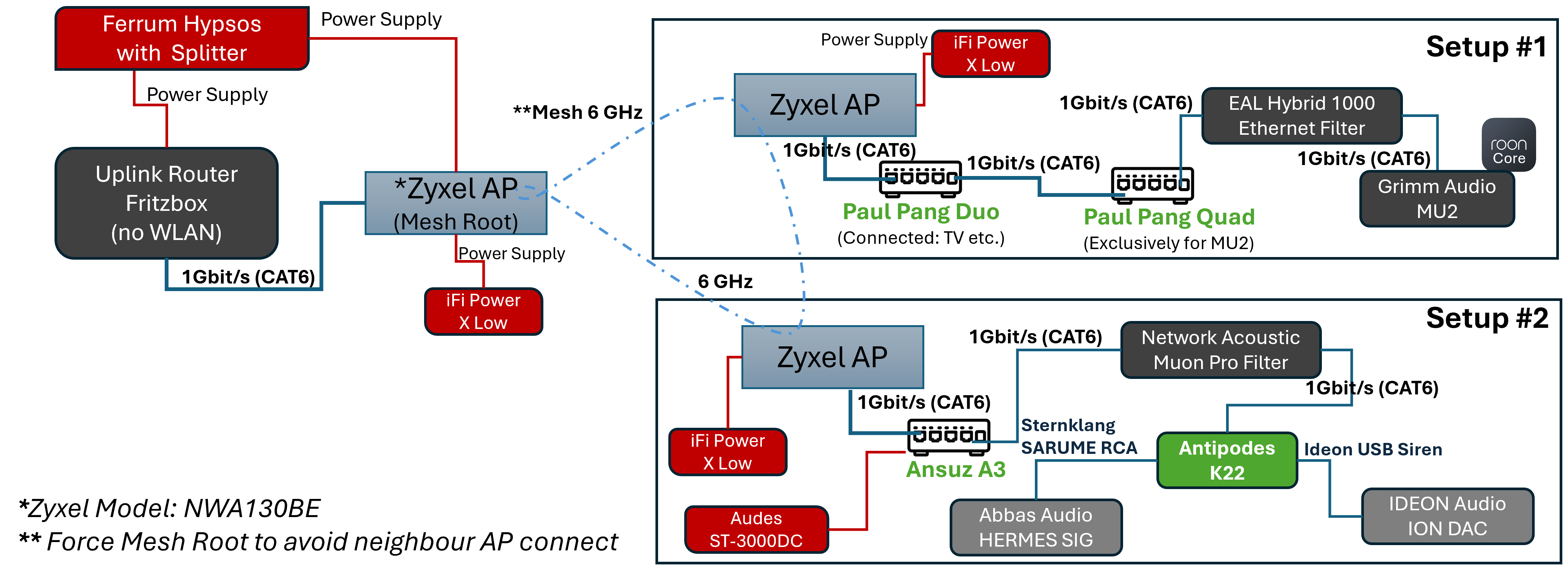
as someone tested over the last 4y+ a lot, I ended up with this design and settled now. Using fiber nor Ethernet cabling was an option. Also using these days decent access point vendors, like Ubiquity, Aruba or Zyxel are working charmly, without any cabling hassle and very stable connectivity!
Also 6GHz Mesh doesnt interfere with common WLAN-/smarthome-/bluetooth APTx devices!
Rgds,
Gerald
2 Likes
I agree with you on wireless for audio reproduction. I’m using TP-Link EAP 235 X3. VHT40 channel width and the Omada controller software hosted as a Docker on my TrueNAS system.
Using SCP I’m hitting ~750Mbps and while wireless is also called ‘never the same air space’ for home use I wouldn’t be surprised if I’m at four 9’s of uptime.
I’m still waiting for someone, anyone, to show me the phase noise at the output of a DAC because of the 25Mhz clock on an Ethernet line.
Hi all,
Reviving this thread to tell you that a recently added Ansuz Powerswitch XTC3 did wonders to my CX+EX+P2 Oladra upgraded stack!
That was using an Ansuz Ethernet D2 between the CX and EX and the original Ethernet from switch to CX.
Then I read here somewhere to try both boxes to the Switch - and boy that actually did wonders too !
So now I guess I need a new D2 Ethernet…
3 Likes
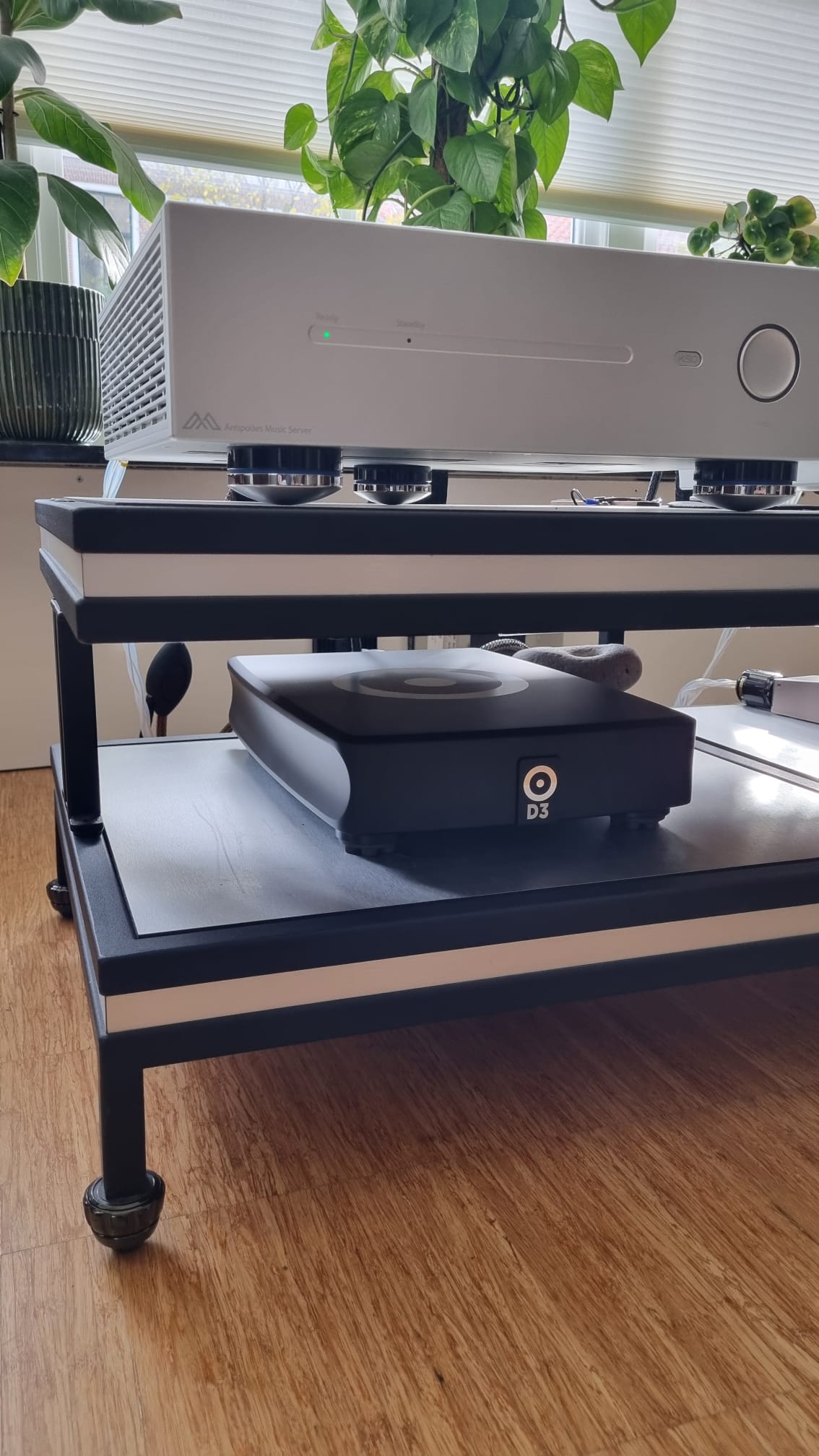
My Ethernet search is now on hold. After discarding a quality power supply, an audiophile Switch, several cascading Switches, several FSPs, some expensive LAN cables, a Powerbox and a well-known Passive Filter, I’ve decided to purchase the Ansuz Powerswitch D3 and the Ethernet Cable D2.
Please read the reviews on Soundnews.net and Hifi-Advice.com and others and see what I mean, they are telling the story 
Robert
4 Likes
I see HiFi Advice has reviewed the JCAT Switch … “What the N1 brings in terms of fluidity and refinement reminds me of the Ansuz Powerswitch D3, but earthier and more neutral, and the Network Acoustics tempus, but more robust and articulate. The Silent Angel combo still sounds more impactful and propulsive, but, as mentioned, this is accompanied by a thicker-than-neutral bass and lower midrange. … On balance, I consider the N1 to be more neutral and certainly more natural.”
“Connected between the N1’s RJ45 connection 4 and the MU1, the muon Pro Ethernet Filter provides a sunnier, more open, and spacious sound than when using the N1’s standard RJ45 connection directly, but it does not achieve the same effect as the N1’s Isolated Output. The main differences are that the N1’s output provides a more solid, focused, and precise rendition.”
But the JCAT cant power Anzus cables like the Powerswitch!
Adding the Ethernet D2 cable and the Darkz T2 feet, the performance with de Ansuz D3 is in my setup ammazing. I did disabled and removed all the stuff under MUSE, choose only one Audio device output, no extra information from the Internet and no background audio analyses. Roon/squeeze is now performing. When i do listen seriously music, I unplug all unnessecary devices (NAS) from my network including powersupplies. It works. Happy me.
Robert
1 Like