Gen 5 upgrade 2026

Finally! Assuming this includes the latest software stack. Check your junk mail if you a subscriber and don’t see it, that is where mine was.

Two new Kala models are planned for release in the third quarter of 2026, alongside Gen 5 upgrades for many existing Antipodes products.

2026 Announcements
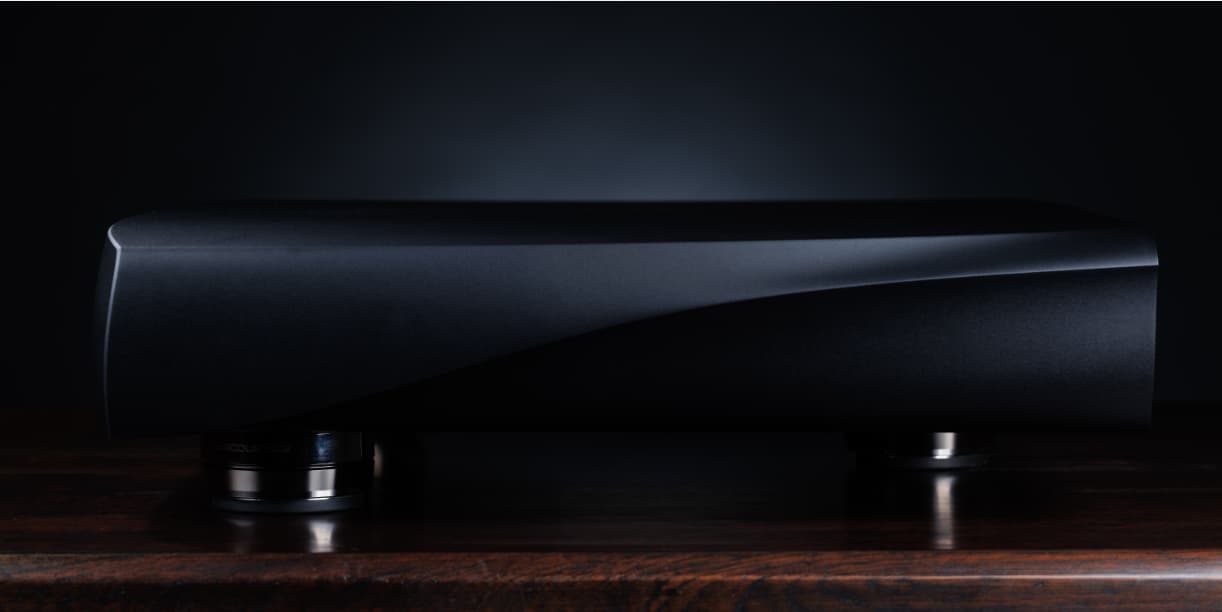
Over the past decade, Antipodes Audio has focused on the digital audio source, recognising that what happens here shapes everything that follows.

Today, we are sharing a defining progression in that work.

We have completed the Oladra Platform — the culmination of a long-standing body of work — and introduced Oladra as a distinct brand dedicated to digital audio sources built on this new foundation.

The Oladra Platform represents a shift in how digital audio systems are conceived. Hardware, firmware, and software are unified as a single architecture, built around a purpose-designed audio computer developed specifically for music.

This brings system behaviour under control at the point where the signal is formed, preserving timing relationships that underpin musical coherence.

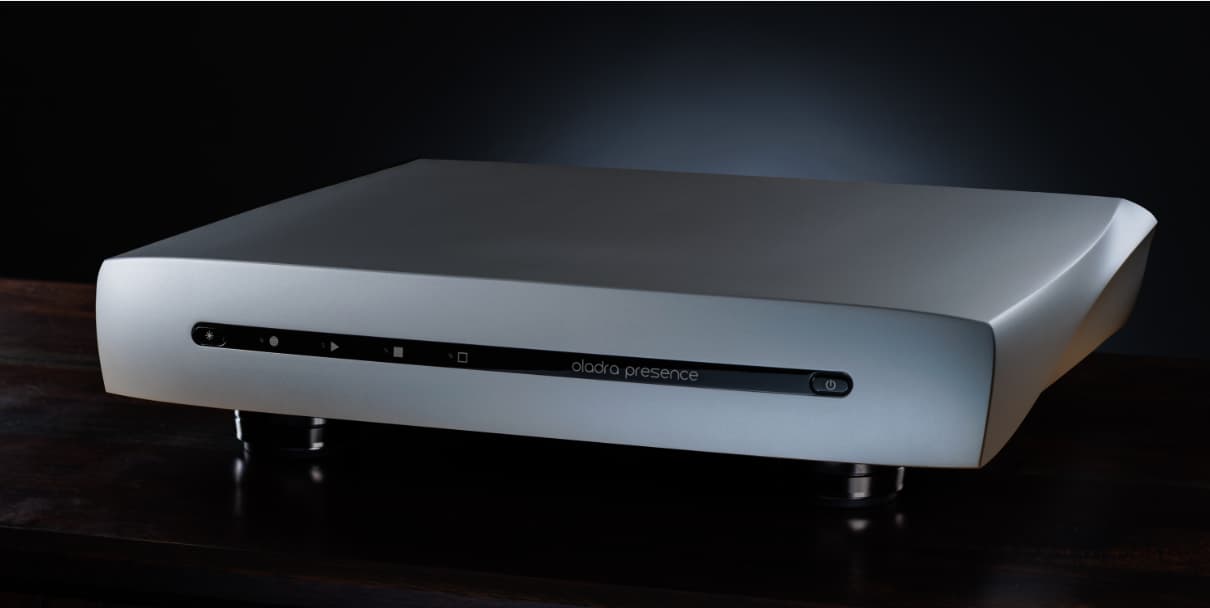
The scale of this architectural step meant it could no longer sit within an evolving product line and required it to stand on its own terms. It is first realised in two models: Sentia and Presence, each sharing the same foundation and differing in degree of refinement.
Antipodes Audio remains the originating company and continues to develop the Kala range. Two new Kala models are planned for release in the third quarter of 2026, alongside Gen 5 upgrades for many existing Antipodes products.

Supporting this transition, we have introduced a revised Antipodes website, a new Oladra website, and Circle — an expanded support environment that brings together guidance, updates, and shared knowledge for those living with our systems.

We invite you to explore further:

Oladra

https://oladra.com

Antipodes

https://antipodes.audio

Circle

https://camerata.audio

Thank you for being part of this work.

Antipodes Audio
1 Like

It will be interesting to see what the G5 upgrade will bring to the current Oladra body and how far that will take it towards the newly announced Presence especially because the Presence does not initially have a BNC output offering (my favoured output on the current Oladra).

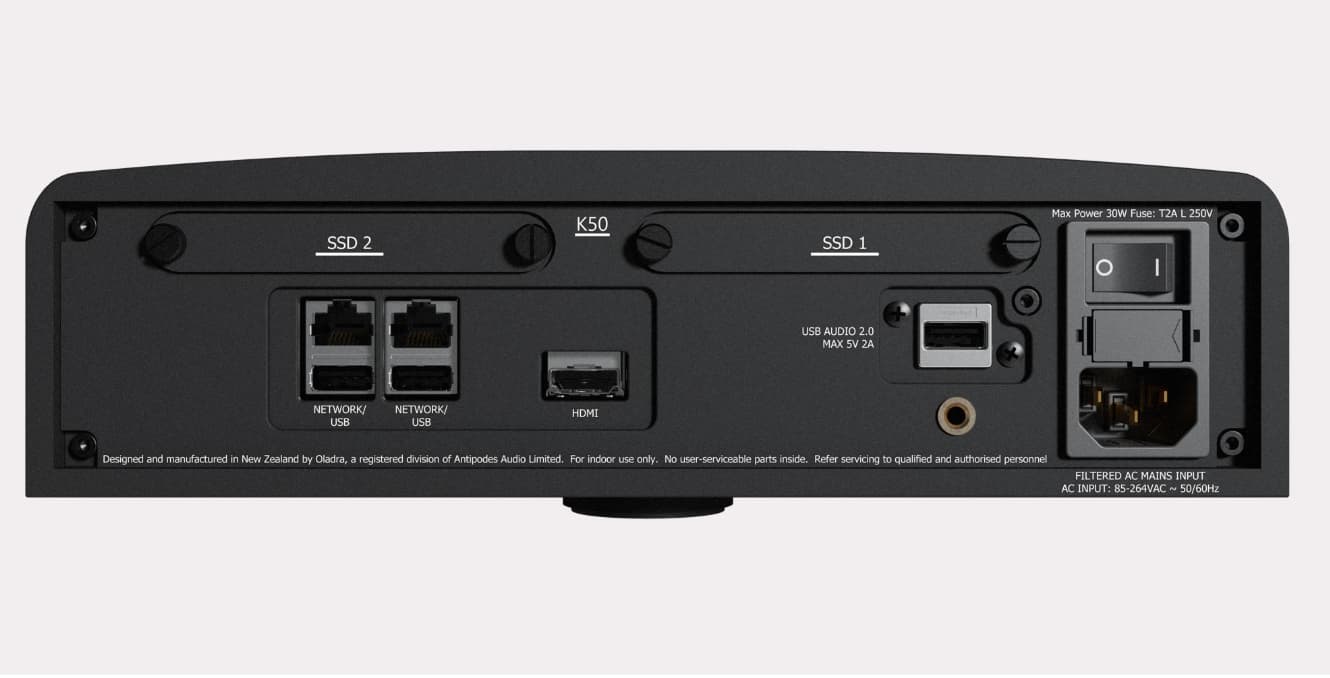
And I use AES in my K50, so when I saw this picture I was a little shocked:

but I just scrolled upon this:

Standard and Specialised Digital Outputs

Oladra offers a standard audio output option for most users, and additional dealer-swappable options for systems with more specific needs.

The standard output is USB only. For the majority of users, this is the best solution: it is supported by nearly every DAC, accommodates the broadest range of formats and sample rates, minimises live ports, power rails, and interfaces, and provides the most universally capable connection between source and DAC. The USB option is available now.

Oladra will offer other dealer-swappable output configurations such as USB + AES3 and USB + S/PDIF, with S/PDIF available on RCA, BNC, or TOSLINK as required. These are provided as alternatives, not additions: only one output may be used at a time, because in digital audio architecture, less is often more.

The same applies to making connections. Where a unit is fitted with, for example, USB + AES3, only the connection in use should be fitted between DAS and DAC. Leaving a second cable connected creates an unnecessary additional path between source and DAC, introducing extra grounding and interface interactions that do nothing to serve the signal.

Some users will want an output shaped around a particular DAC. These may include options such as Dual-AES, I2S with clock-slaving, or other DAC-specific interfaces, as outlined on the Connections page. Oladra will progressively release these specialised output options over time.

So the approach is simple: USB for most users, and carefully chosen alternatives where a particular DAC or system calls for something more specific.

Streaming to a DAC over Ethernet

Some DACs accept audio over Ethernet, and some users wish to use this approach.
Antipodes DAS have facilitated this in the past giving the server two Ethernet ports: one for the network, and one for the DAC, with the DAC effectively reaching the network through the server.

The Oladra Platform approaches this differently. Instead of the server performing that switching role, the Oladra platform is designed to use a dedicated three-port switch, with the Oladra and the DAC each connected to the switch, and the third port connected to the network.

The reasoning is simple: if Ethernet distribution is required, it is better handled by a high-quality low-noise switch than by the server itself. That keeps the roles clearer, and the solution more purposeful. The switch serves the additional purpose of improving audio performance with streaming services.

Oladra will release an ideal switch for this use. Until then, the same principle applies with a well-designed audiophile switch.

https://camerata.app/outputs

1 Like

Hopefully with G5 update the current OLADRA can be fitted with the I2S with clock slaving which can be matched with MSB.

Do I have to send my K50 to New Zealand for G5 updates? What is the price for the update?

1 Like

I like this approach. Thanks for posting that.